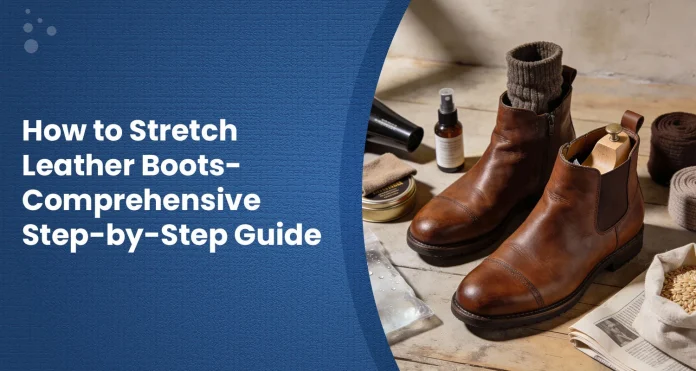
new pair of leather boots can feel firm across the toes, sides, instep, or shaft before the material begins to soften. Learning how to stretch leather boots can help relieve mild pressure and improve comfort, but the process should be gradual to avoid damaging the leather, stitching, lining, or overall shape.
Can Leather Boots Be Stretched?
Genuine leather has natural flexibility and may loosen slightly with wear. The amount of movement depends on the leather type, thickness, construction, lining, and area causing discomfort.
Boots can often be widened a small amount across the forefoot, toe box, instep, or shaft. They may also be stretched around a specific pressure point, such as a bunion or prominent toe joint.
However, stretching cannot meaningfully increase the length of a boot. If the toes are pressed firmly against the front or curl while standing, the boot is probably too short. Stretching may also be limited in footwear made from synthetic materials, heavily reinforced leather, safety-toe construction, or waterproof membranes.
The goal should be to relieve mild tightness rather than force an incorrect size to fit.
Check the Fit Before Stretching
Before using any stretching method, identify exactly where the boot feels tight. Walk indoors for several minutes while wearing the socks normally used with the footwear.
Pay attention to whether the pressure is located at the toes, ball of the foot, instep, heel, ankle, or calf. Marking the outside of the boot lightly with removable tape can help identify the area that needs attention.
The heel should remain reasonably secure, and the toes should have enough room to move. Mild pressure across the width may improve, but numbness, sharp pain, severe pinching, or toes touching the front indicate a sizing issue.
It is also important to check the return policy before wearing the boots outdoors or applying sprays. Once footwear has been altered, it may no longer qualify for a return or exchange.
Method 1: Wear Thick Socks Indoors
One of the gentlest ways to loosen leather boots is to wear them indoors with thick socks. This method uses body heat and natural movement to soften the material gradually.
Put on one thick pair of socks, or layer two thinner pairs if the boots still fit safely. Wear the boots for 20 to 30 minutes while walking around the house.
Remove them if you experience numbness, strong pain, or restricted circulation. Repeat the process over several days rather than wearing painfully tight footwear for hours.
This method works best for mild tightness across the forefoot or instep. It may not provide enough pressure for stiff leather or a concentrated trouble spot.
Method 2: Use a Boot Stretcher
A boot stretcher provides controlled pressure and can be useful when a more noticeable width adjustment is needed. Different models are made for the toe box, instep, calf, or overall width.
Insert the stretcher fully into the boot and turn the handle until it feels snug. Increase the pressure slowly. The device should press against the leather without forcing the seams or distorting the shape.
Leave it in place for several hours or overnight, depending on the manufacturer’s directions. Release the pressure, remove the stretcher, and try on the boot.
Several mild stretching sessions are safer than one aggressive attempt. Over-tightening can weaken stitching, damage the lining, or create an uneven shape.
Some stretchers include small plugs that target bunions, corns, or specific pressure points. These can be placed in the relevant holes before inserting the device.
Method 3: Apply Leather Stretching Spray
Leather stretching sprays are formulated to help soften leather fibres temporarily. They are often used with thick socks or a mechanical stretcher.
Test the spray on a small, hidden section first. Some products may darken, stain, or alter the finish of certain leathers, including suede, nubuck, and light-coloured materials.
Apply a small amount to the tight area according to the product directions. Wear the boots or insert a stretcher while the leather is slightly softened.
Avoid saturating the material. Too much liquid can affect the colour, adhesives, lining, and shape. The boots should be allowed to dry naturally after treatment.
Only use products specifically labelled for the type of leather involved.
Stretching Specific Pressure Areas
Different fit problems require different methods. Tightness across the ball of the foot may respond well to a width stretcher, while pressure on the top of the foot may require an instep stretcher.
For a tight toe box, look for a device designed to expand the front section. Keep in mind that steel-toe, composite-toe, and heavily reinforced boots may not stretch in this area.
A narrow boot shaft may be loosened with a shaft stretcher, but zips, elastic panels, stitching, and decorative elements can limit how far the leather can move.
For a bunion or other concentrated pressure point, a plug-style stretcher allows pressure to be applied to one small section rather than widening the entire boot.
Stretching both boots equally is not always necessary. Feet often differ slightly in size, so it may be better to treat only the boot causing discomfort.
Stretching Methods to Avoid
Several popular home methods carry a high risk of damage. Soaking boots in water can cause staining, shrinking, warping, weakened adhesives, or stiff leather once the material dries.
Direct heat from hair dryers, heaters, radiators, or ovens can dry out leather and cause cracking. It may also damage waterproof linings, glues, and synthetic components.
Freezing water-filled bags inside boots can place uncontrolled pressure on the seams and lining. The bags may leak, and the expanding ice may distort the footwear.
Stuffing boots with hard objects or forcing oversized items inside can create uneven stretching. Household alcohol mixtures may also remove finishes or dry the leather.
Controlled pressure and leather-safe products are generally better choices than extreme heat, moisture, or force.
When to Visit a Cobbler
A professional cobbler is the safer choice for expensive boots, delicate leather, lined footwear, vintage pairs, or boots with complicated construction.
Cobblers have stretching machines designed to apply pressure evenly. They can often target the width, instep, toe area, shaft, or a particular pressure point while reducing the chance of visible damage.
Professional assistance is also advisable when a boot has safety toes, waterproof membranes, heavy stitching, zips, or decorative panels that could be affected by stretching.
A cobbler can also determine whether stretching is realistic. In some cases, exchanging the footwear for a wider size or different shape will provide a better result.
Leather boots often become more comfortable through gradual wear, but careful stretching can help when a specific area feels slightly too tight. Visit BootsPlusMore for additional boot-care guidance and footwear options designed for work, uniform, tactical, and everyday use.